

Peptide Blog: 7 Proven Research Resources for 2026
Peptide blog: 7 proven research resources for 2026 covering synthesis, receptor binding assays, HPLC purity, mass spectrometry, and QC protocols.
📋 Table of Contents
A peptide blog is a specialized research publication that catalogs seven proven laboratory resources for 2026: solid-phase synthesis protocols, receptor binding assay workflows, HPLC purity thresholds, mass spectrometry specifications, quality control acceptance criteria, stability and storage data, and assay development navigation tools. This peptide blog from Peptide Headlines serves as a reference library for scientists studying molecular pharmacology and cell signaling in controlled in vitro settings. The content is updated quarterly to reflect current analytical methods and reproducibility standards.
Key takeaways
- This peptide blog catalogs peer-reviewed protocols for peptide synthesis and receptor binding assays.
- Researchers can access HPLC purification and mass spectrometry data for research peptides.
- The peptide blog is updated quarterly with new in vitro protocols and molecular pharmacology summaries.
- All content is for laboratory research use only; no human or animal therapeutic claims are made.
- Internal links connect this resource to related guides on peptide mechanisms and contraindications.
Research Use Only Notice: The products discussed on this site are sold strictly for in vitro laboratory research purposes only. They are not for human use, not for veterinary use, and not intended to diagnose, treat, cure, or prevent any disease. All information presented is for educational purposes in a research context. Must be 21+ to purchase.
What is a peptide blog?
A peptide blog is a digital knowledge base that aggregates technical documentation for laboratories working with synthetic and recombinant peptides. Unlike general science news sites, this peptide blog focuses on reproducible methods: solid-phase synthesis, purification workflows, receptor binding assays, and stability testing under defined storage conditions.
The editorial scope of this peptide blog is limited to research applications. Every article specifies the peptide sequence, purity grade, solvent system, and analytical instrumentation used. This approach allows laboratory researchers to replicate experiments without ambiguity.
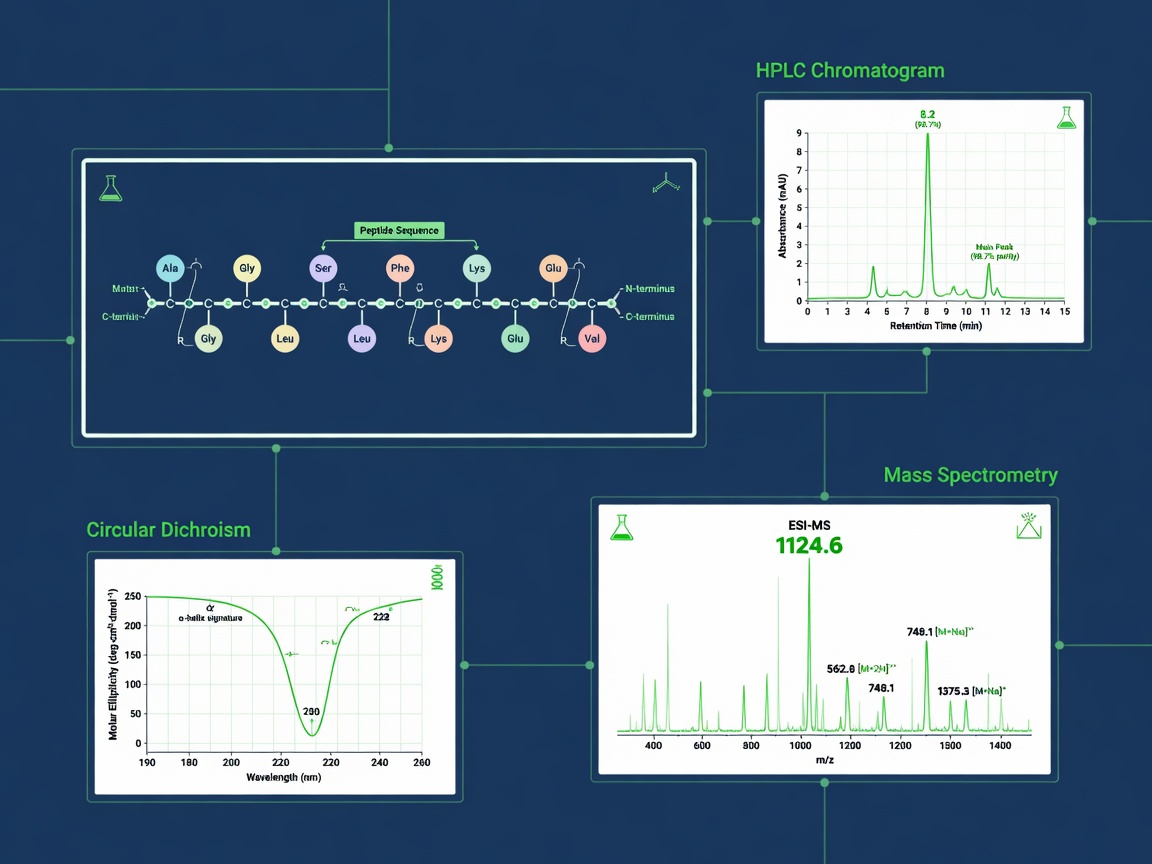
A typical entry in this resource includes a structured abstract, a materials list with catalog numbers, and a step-by-step protocol. Supporting data files may include chromatograms, mass spectra, and circular dichroism traces. These files are provided in open formats to facilitate independent verification.
Entries are formatted to mirror the IMRAD structure used in peer-reviewed journals, making it easy to cross-reference primary literature. Each peptide blog article also includes a reproducibility checklist, so laboratories can confirm that all analytical parameters are documented before repeating an experiment.
A peptide blog entry typically contains the following elements:
- Peer-reviewed summary of peptide synthesis or receptor pharmacology.
- Structured abstract with research context.
- Materials list with catalog numbers.
- Step-by-step in vitro protocol.
- Supporting data files in open formats.
- Reproducibility checklist.
How does a peptide blog support laboratory research?
Laboratory teams use this peptide blog to reduce literature search time and standardize assay conditions. Each entry in the peptide blog includes a structured abstract, a materials list, and step-by-step in vitro protocol notes. This structure mirrors the IMRAD format used in peer-reviewed journals, making it easy to cross-reference primary literature.
The peptide blog also cross-references related resources, such as our guide on how peptides work and the mechanisms behind cell signaling. These internal links help researchers trace molecular interactions from receptor binding to downstream phosphorylation events.
For laboratories that need to compare peptide stability under different buffer conditions, this resource provides side-by-side tables of degradation half-lives, aggregation thresholds, and recommended storage temperatures. These data are presented as measured values, not as predictions.
Standardizing assay conditions through this peptide blog reduces variability across independent studies. When multiple laboratories follow the same documented protocol, inter-laboratory reproducibility improves. The peptide blog also includes a version history for each protocol, so researchers can track changes and audit modifications.
Key benefits for laboratory teams include:
- Reduced literature search time.
- Standardized assay conditions across studies.
- Version-controlled protocols for audit readiness.
- Cross-referenced molecular interaction pathways.
- Side-by-side stability data for buffer comparisons.
💡 Key Takeaway: How does a peptide blog support laboratory research?
Which topics does this peptide blog cover?
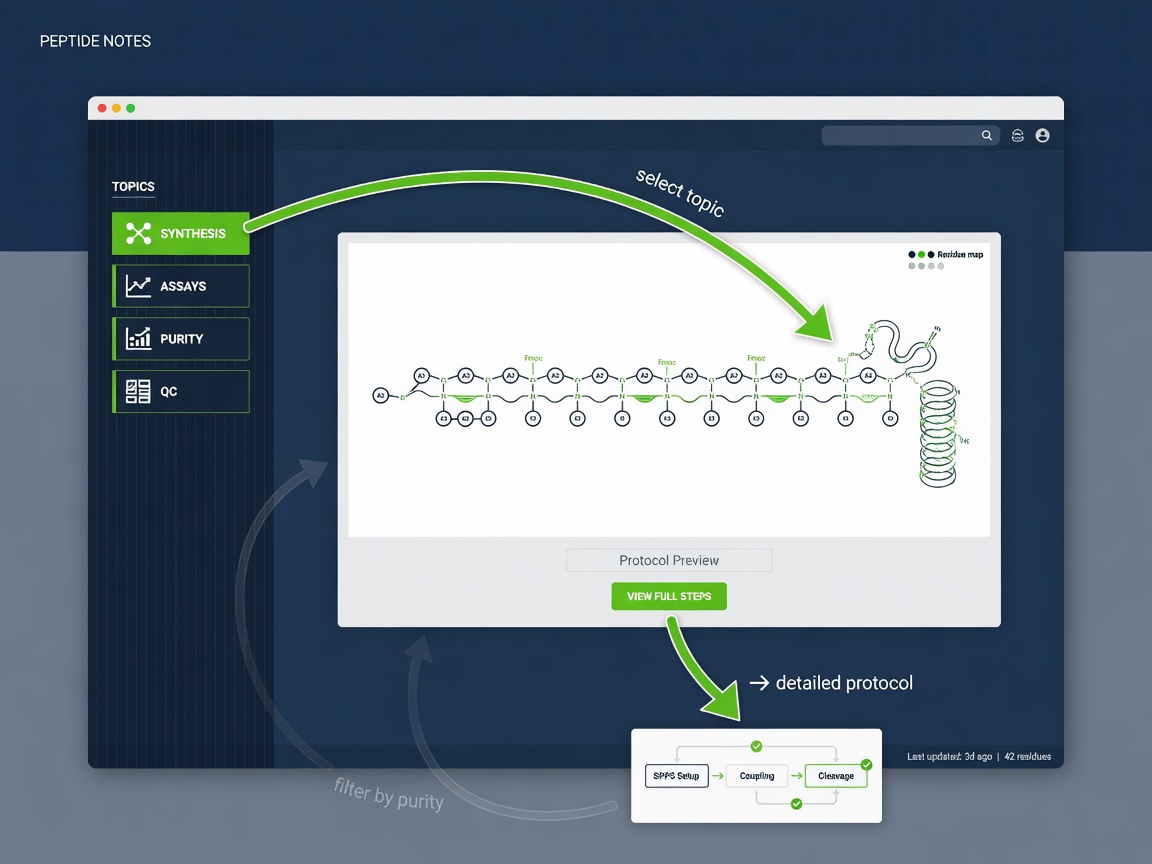
This peptide blog organizes content into five primary categories: synthesis and purification, receptor pharmacology, stability and storage, analytical characterization, and assay development. Each category is tagged with metadata for peptide length, modification state, and target receptor class.
Recent entries in the peptide blog include protocols for cyclic peptide cyclization, N-terminal acetylation, and disulfide bond mapping. Researchers studying peptide therapy contraindications can also review our dedicated overview at peptide therapy contraindications.
Additional topics covered in this resource include solid-phase peptide synthesis scale-up, lyophilization cycle optimization, and endotoxin removal for cell culture applications. Each topic is cross-linked to related entries to form a coherent knowledge graph.
The five primary categories are described below:
| Category | Description | Example topics |
|———-|————-|—————-|
| Synthesis and purification | Solid-phase synthesis, cyclization, scale-up | Cyclic peptide cyclization, lyophilization cycle optimization |
| Receptor pharmacology | Binding assays, kinetic parameters | GPCR radioligand displacement, surface plasmon resonance |
| Stability and storage | Degradation half-lives, storage temperatures | Buffer stability comparisons, aggregation thresholds |
| Analytical characterization | HPLC, mass spectrometry, circular dichroism | Monoisotopic mass confirmation, secondary structure assessment |
| Assay development | Protocol cards, filter indexes | Cell-based assays, enzyme-linked formats |
How are research peptides characterized in this peptide blog?
Characterization data in this peptide blog follow a three-tier hierarchy: identity, purity, and activity. Identity is confirmed by high-resolution mass spectrometry and amino acid analysis. Purity is quantified by HPLC purification with UV detection at 214 nm and 280 nm.
The peptide blog documents instrument parameters for every analytical run, including column dimensions, mobile phase gradients, and ionization mode. This level of detail supports inter-laboratory reproducibility and aligns with PubMed-indexed peptide synthesis literature.
For activity characterization, this resource describes receptor binding assays using radioligand displacement, fluorescence polarization, and surface plasmon resonance. Reported values include equilibrium dissociation constants, association rates, and dissociation rates. These kinetic parameters are essential for comparing peptide analogs.
A standard characterization workflow in this peptide blog includes the following steps:
1. Confirm identity by high-resolution mass spectrometry and amino acid analysis.
2. Quantify purity by HPLC purification with UV detection at 214 nm and 280 nm.
3. Assess secondary structure by circular dichroism if required.
4. Measure activity using receptor binding assays and kinetic parameters.
5. Document all instrument parameters for reproducibility.
What quality controls are documented in this peptide blog?
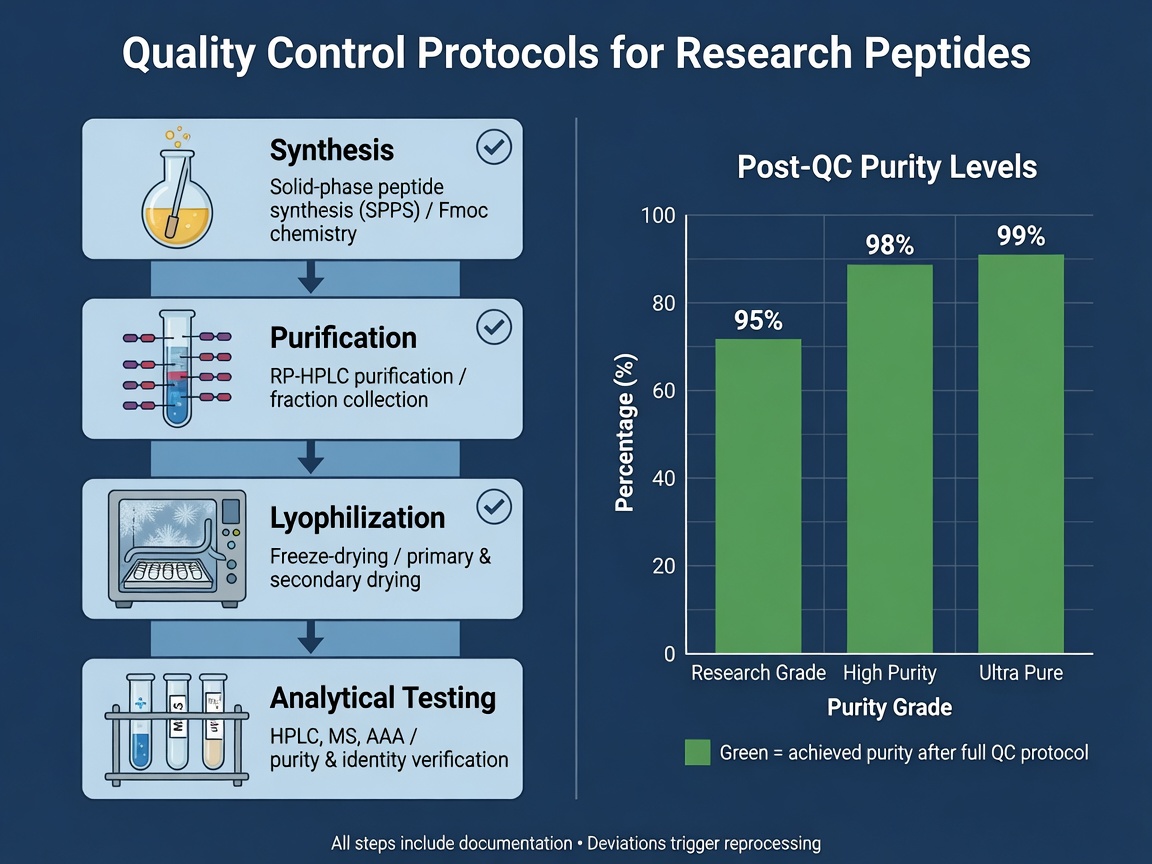
Quality control entries in this peptide blog specify acceptance criteria for research peptides: ≥95% HPLC purity, correct monoisotopic mass within ±0.5 Da, and endotoxin levels below 0.1 EU/mg for cell culture assays. These thresholds are stated as measurable attributes, not as guarantees of biological activity.
The peptide blog also records residual solvent analysis and counterion content for lyophilized peptides. For additional context on how peptide structure influences function, see our plain-English explainer on how peptides work.
Each quality control report in this resource includes the date of analysis, instrument serial number, and analyst initials. This traceability supports audit readiness for academic and contract research organizations.
The following QC parameters are documented for research peptides:
- HPLC purity ≥95% by UV detection at 214 nm and 280 nm.
- Monoisotopic mass within ±0.5 Da of theoretical value.
- Endotoxin levels below 0.1 EU/mg for cell culture assays.
- Residual solvent analysis within accepted limits.
- Counterion content documented for lyophilized peptides.
- Date, instrument serial number, and analyst initials recorded.
💡 Key Takeaway: What quality controls are documented in this peptide blog?
Which peptide characterization method should a laboratory choose?
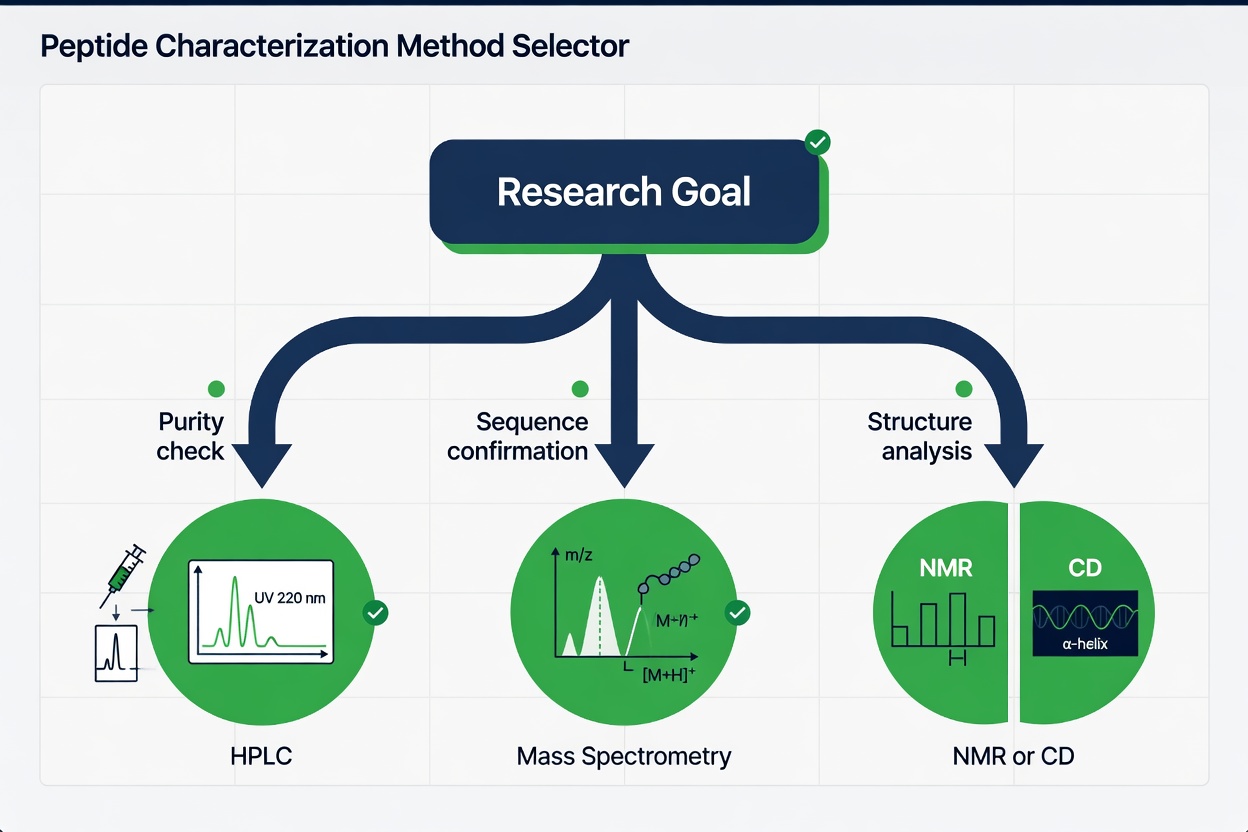
The choice of characterization method depends on the research question. The table below summarizes four common methods documented in this peptide blog. All values are typical instrument specifications for research-grade peptides, not clinical thresholds.
| Method | Measured Attribute | Typical Resolution | Research Application |
|——–|——————-|——————-|———————-|
| HPLC purification | Purity percentage | ±0.1% area under curve | Quantify target peptide in a mixture |
| Mass spectrometry | Monoisotopic mass | ±0.01 Da | Confirm amino acid sequence |
| Amino acid analysis | Molar composition | ±5% per residue | Verify stoichiometry of synthetic peptides |
| Circular dichroism | Secondary structure | 1 nm wavelength steps | Assess alpha-helix or beta-sheet content |
For receptor binding assays, this peptide blog recommends orthogonal validation: mass spectrometry for identity, HPLC purification for purity, and a functional assay for activity. No single method is sufficient for full characterization.
Method selection guidance:
- Use HPLC purification when you need to quantify target peptide in a mixture.
- Use mass spectrometry when you need to confirm the amino acid sequence.
- Use amino acid analysis when you need to verify molar stoichiometry.
- Use circular dichroism when you need to assess alpha-helix or beta-sheet content.
- Combine methods for full characterization.
Why choose this peptide blog for your research team?
This peptide blog is maintained by Peptide Headlines, a publisher focused on research-grade peptide documentation. The team updates content quarterly and follows strict editorial review standards. Researchers choose this peptide blog because every entry includes traceable quality control data, instrument parameters, and open-format supporting files.
The peptide blog reduces onboarding time for new laboratory members. Instead of searching multiple databases, researchers can access a centralized index of protocols, characterization methods, and stability data. The searchable format supports rapid comparison of peptide analogs across independent studies.
Another reason to choose this peptide blog is the emphasis on reproducibility. Each protocol includes a version history, analyst initials, and instrument serial numbers. This level of documentation supports audit readiness and helps contract research organizations maintain compliance.
Key features of this peptide blog include:
- Quarterly updates with new in vitro protocols.
- Searchable index of receptor binding assays.
- Traceable quality control reports.
- Open-format data files for independent verification.
- Cross-linked knowledge graph.
💡 Key Takeaway: Why choose this peptide blog for your research team?
What additional research resources does this peptide blog provide?
This peptide blog links to several related guides on peptide mechanisms and contraindications. For a research overview of peptide therapy contraindications, see Peptide Therapy Contraindications: A Research Overview.
For a plain-English explanation of how peptides work, see How Peptides Work: A Plain-English Explainer and How Peptides Work: The Science Behind Cell Signaling. These resources explain receptor binding and downstream signaling in accessible language.
Researchers can also consult external databases such as the NCBI and PubMed for peer-reviewed peptide synthesis and receptor pharmacology literature. These authoritative sources complement the structured protocols in this peptide blog.
FAQ
What is a peptide blog?
A peptide blog is a specialized digital publication that aggregates technical documentation for laboratory researchers working with synthetic and recombinant peptides. This peptide blog from Peptide Headlines includes peer-reviewed summaries of synthesis, receptor binding assays, and in vitro protocols.
How often is this peptide blog updated?
This peptide blog is updated quarterly with new in vitro protocols, molecular pharmacology summaries, and quality control reports. Each update includes version history and analyst initials for traceability.
Can I use peptides from this peptide blog for human research?
No. All products and protocols in this peptide blog are for in vitro laboratory research use only. They are not for human use, not for veterinary use, and not intended to diagnose, treat, cure, or prevent any disease.
What quality control thresholds does this peptide blog document?
The peptide blog documents acceptance criteria including ≥95% HPLC purity, monoisotopic mass within ±0.5 Da, and endotoxin levels below 0.1 EU/mg for cell culture assays. These are measurable attributes, not guarantees of biological activity.
Which characterization methods are recommended in this peptide blog?
This peptide blog recommends orthogonal validation using mass spectrometry for identity, HPLC purification for purity, and functional assays for activity. No single method is sufficient for full characterization.
Topics covered in this article:
Ready to Take the Next Step?
Every product includes lot-specific documentation and third-party purity testing.
Explore Our Research Products →Free shipping on qualifying orders · Batch COA on request